Showing posts with label Research (Course work). Show all posts

Thursday, 9 May 2013

Main Film synopsis

A Guide to Kill
After the death of his wife, a man sets himself out on a violent, bloody mission to put down the men who killed his pregnant wife by taking the law on his own hands. What the men don't know is what the punishment for their crimes will be, with prison certainly being out the question.

The Synopsis
 The scene begins with dead bodies scattered around the room, with a mysterious figure appearing to walk around the bodies later to be identified Damien Tucker (Brolin Zinga). A beaten up figure appears laying on the pillar of the room, Mr Gilstrap (Charlie Jones) demanded Tucker to kill him. Mr Gilstraps daughter then appears to the room staring at her father in shock then taken to the chair and is told by Tucker a story of the bad things her father has done.

The film then begins with Tucker and his wife, Delores Anne-Tucker, who looks between 4-6 months pregnant appearing out of church as they have just been married. On their way home, Tucker tells his wife how he would never let anything happen to her because of the work he does, as he is part of the metropolitan S.W.A.T team. Two days after their marriage, just when the newlyweds are about to sleep, a car pulls over outside their suburban house, with five armed men bursting through their door. Tucker runs downstairs with a baseball bat only to get knocked out by tallest of the armed men with his M16. Delores is then dragged out of bed and is whispered by one the armed men "your required answer from Gilstrap" and is then shot in the head and stomach with a 9mm pistol. The men plant the gun in Tuckers hand run out the house.

In prison, Tucker meets up with Tommy Twotakes, a man who used to work for Gilstrap but is willing to testify against him, tells Tucker that the woman who was murdered was killed because she wanted to run away with Gilstrap and have his baby, which she was carrying and if he didn't agree, he would tell his wife, not knowing that the woman he was talking about was Tuckers wife, laughing about it. Tucker then asks how he could get hold of Gilstrap and work for him and Tommy reveals all.

Tucker, released after 2 years with not enough evidence to put him away, goes to the bar where Mr Gilstrap owns. Gilstraps bar is attack by 3 columbians and Tuckers takes out 2 of them, and then is offered a job for Gilstrap.

As time passed, Tucker becomes his right hand man shown through the montage then returns to Tucker and Gilstraps daughter who pleas to Tucker not to kill her father, but instead, Tucker shoots him in the head 3 times and tell his daughter it wasn't business, it was personal.

Friday, 3 May 2013

Planning for our main task

After our preliminary task, we realised that thorough planning for our main was a necessity. We therefore split off to create different parts for the plan. We had the ideas that we would use Mr Hughes' office (headteacher) as a location. However his busy schedule meant we couldn't have the office for long enough, we therefore went to the common and only used a section to for filming. We tried to make it look like a penthouse or hotel room with its high windows etc.. However the plans created were for Mr Hughes' office. If we had time we would have changed the plans for the new location, however we were very pressed for time due to light constraints and various deadlines.


I created the call sheet, this was important as we need to know who needs to turn up when and so on. If we neglected to make the call sheet, it would have resulted in chaos and people turning up when they werent needed and vice versa. Organisation is key for anything that requires team work. This is why the call sheet was important for our groups success.


Brolin created the shot list, we both worked on the storyboard so we know what we wanted to do in the film, after this we created a label for each shot, we then listed the time we would be filming it, the shot number, a description of the shot as seen on the storyboard, the location, characters seen in each shot and props (mise-en-scene) in each shot. This was important as it meant we knew what we had to do. If we had left it and gone with the flow like our preliminary task, we would have been stuck and the filming process would have taken a lot longer.

I then created a storyboard so that we could plan what was going to happen in each shot. It's an important part of the process as it can make the filming process a lot more efficient if you know what you want from each shot. Here are our storyboards:


We also created floor plans. We inspected the set so we knew what it would look like when were filming. We did this to know where the props were, the actors, camera and lights were. This is very important in the planning process. Also We did it to ensure we never broke the 180 degree rule. Yusuf drew a line to indicate which side of the action we had to be when filming. This made the actual filming of the film much more efficient.


Monday, 15 April 2013

Main Task Script

Here is the script for our main task. I think it highlights the main conventions of a thriller.


Friday, 22 March 2013

Opening Credits for Our Main Task.

Our main task, as seen in an earlier post, is a thriller all about one man getting revenge on the man that has murdered his wife, child and framed HIM for the murder. The opening scene is actually the last scene of the film. It then travels back in time to the opening credits.

We want our credits to be somewhat tense, to create this we want to use the computer as it will not only make the film look professional, but most thriller/mystery films don't have big upbeat opening credits unless trying to subvert the audiences expectations. As we have shown the last scene, we want to continue down the same genre path.

The first film's credits to inspire us was 'The International' as it has a sense of calm, the titles appear next to Clive Owens face and around the scene, the sense of serenity creates an air of tension and suspense. Exactly the feeling we want top create through our opening scene.

Another film that has good opening credits is Quentin Tarantino's film - Reservoir Dogs. The fact the upbeat music lulls the audience into a false sense of fun, we then have the sounds of screaming creep over the top of the music. The screaming gets louder and louder as the music fades out, the black out then cuts to the end scene of the film. I like this because the audience are enjoying themselves unsure of  what is going to happen, they are then shocked and drawn into the sudden action on the screen. The fact they have the climax of the film at the beginning really captures audiences attention as they want to know how the plot ended up with this bleeding man in the back of a car.

Overall I like the idea of starting the film with the final scene to capture the audiences attention, although the upbeat music doesn't support our genre, so when composing the music we will be hoping to create something with more tension, which is why the slow, calm introduction of the credits in The International works.

Opening credit analysis.

Opening credit analysis. 

Hello Lonesome.

- What is the genre of the film?
The genre of the film is a drama. It's about six lonely souls who all find love.

- Explain the style, (CGI, drawn, film?)
Special effects. It takes the place of an ideal world, big white houses, open spaces, the nose of traffic quietened. The music offers something quite sinister.

- Explain how the style supports the genre of the film
The sinister music highlights the style of a drama genre as it always has a sinister undercoating which has been buried for a long time and finally comes to pass. 

- How does it introduce you to the film?
We are intrigued by the serenity of this playful world. They are toys therefore giving us an impression of innocence in the film.

- How does it draw you into the film?
We are interested in the alternate world of playfulness yet the stillness of everything gives us a sense of mystery. 

- How is the font used? What effect do they have? How does it link to the films genre?
Its white, block writing, very clear and simple, however they look as though they cast shadows making us feel as though they in this world. 

- What type of transitions are used by the editor? What effect do they have?
Normal shot to shot cuts. Nothing special, no editing effects used. It doesn't overwhelm the audience. We are eased into this film.

- How do the titles reflect the THEME of the film? 

The block writing amongst the still toys could show how the characters are searching for something amidst a world that has stood still for them. The titles are so obvious which gives the impression of hope. 

Hansel and Gretel: Witch Hunters.

- What is the genre of the film
Action/Adventure.

- Explain the style, (CGI, drawn, film?)
GGI, the camera moves through a fiery cartoon of the events of Hansel and Gretel's lives. 

- Explain how the style supports the genre of the film
The fire and dark colours highlight the sinister atmosphere of the film. Also the constant movement of the camera highlights the fast pace of an action film. 

- How does it introduce you to the film?
We are excited by the flames and sinister colours. Our attention is immediately grabbed.

- How does it draw you into the film?
We are interested in the the newspaper titles as they are providing us with introductory information. We have to read it to understand. 

- How is the font used? What effect do they have? How does it link to the films genre?
The font appears around the action so it doesn't take away attention from the opening film. The white font means we see it but not too much. The old lettering highlights the setting of the film. 

- What type of transitions are used by the editor? What effect do they have?
Quick transitions to highlight the action element of the film. The film is constantly moving.

- How do the titles reflect the THEME of the film?

Burning, chaos, quick transitions. Highlight the excitement of the experience and the action element.

Different types of editing.


Different types of editing:

There are many different types of editing used in film. However today I was looking at a 'match cut' which is the link between two different objects or two different spaces. This is done to 'link the scene' despite filming the two things separately. It helps to create match on action. This is an example from Alfred Hitchcock's film - 'The Birds' in which Tippi Hedran is simply walking to a shop, the match cut helps to create this match on action. Also - Watch out for  Hitchcock's cameo toward the end of the clip.


Editing Task


Editing.

We were all given the task of finding 10 random pictures on google. These are my results:

  I found a group of 'chavs,' a peaceful road, a sad old man, a war torn street, the furniture building which was set alight during the London riots, a car driving away, a group of men from the 1930's, the map of Alaska from the simpsons and an old man walking alone. 

We were then given the task of taking these images and changing their order to create a story. This was the end result:
Shot 1 is a representation of the London riots and the disaster and mayhem that young people caused. This then leads into an empty, ruined street, highlighting the after effects of what occured as a result of the actions of young people in today's society. We then introduce the protagonist, a lonely old man who is shunned by a teenage society. We then see the society that the main character grew up in and how happy he was. Shot 5 is his depressed facial expression and what today's society consists of which leads into the image of a bunch of chavs sitting on a fence.We, as an audience, stereotypically assume that they are up to no good. A gross generalisation, but as the first image highlights, we have created this image, only we are to blame for the stereotypes with which we are branded. Shot 7 is a clear road, we see in the rear view mirror, a dirty track, thus highlighting the road ahead is a bright one, thus leading into the image of this view of 'eternal bliss' in the future. The final shot highlights the end of the characters search for a state of eutopia.
The meaning of the pictures change when placed in a different order, which is something directors think about when creating their films. However the dialogue tells us everything we need to know.

The BAFTA's


The BAFTA's.

I recently watched the BAFTA's and found some of the award winners undeserving. However some awards were spot on.

I have a passion for acting and aspire to be an actor one day, hopefully winning a BAFTA. My role models are such brilliant actors like: Christoph Waltz, Daniel Day Lewis, Tom Hanks and many more.

This is why I am happy that Christoph Waltz won the award for his role in Django Unchained. He is a phenomenal actor who manages to take a sinister character and twist it to contain elements of humour and tension, which adds to the sinister characteristic.
The sheer volume to which Daniel Day Lewis prepares for a character is brilliant. He chooses his parts very carefully and will live as that part for a huge amount of time just so that he can feel as though he is that person, this leads to a superb performance in every film and I am happy he won the award for Best Actor.


However, when it comes to directors, I am disappointed that Ben Affleck won the award for Best Director. He went off the rails for such a long time and appeared in some terrible films, he even ruined one of my favourite films - 'Pearl Harbour.' However he makes one good film - Argo - and all of a sudden he is worthy of a BAFTA, when some of the other directors there such as Quentin Tarantino and Ang Lee have gone on to make some magnificent films. Ang Lee directed the smash hit - Brokeback mountain. And while it isn't my kind of film, it has been classed as one of the best directorial displays in the world. Ang Lee won the Bafta for this film. Quentin Tarantino has directed so many classic films, (which he has also written), like Pulp Fiction and Inglorius Basterds. Yet Ben Affleck claims the accolade for a film that refuses to carry the same emotional depth as Django and French film - Amour - which, for its sheer emotional baggage, should have been nominated for Best Film.
Tom Hooper wasn't even nominated for the award. Although I haven't seen Les Miserables. I know people that have and they are calling it a triumph. The idea of having actors singing live makes the scene seem so real. And it is smart decisions like this which makes Tom Hooper one of the best Directors of our day. (The King's speech).
So the message of this is: Ben Affleck didn't deserve the award he was credited with, as there are so many other directors who have made better films in the last 8 months.

Target Audience.


Audience.
We are doing action, mystery, crime. We are doing opening credits in this style as we want it to be intriguing and exciting. From our research we found that the opening credits of a lot of action films are the most creative. For example Reservoir dogs or Kill Bill.
As a group we looked at the most common audience with action films.
We found that young people aged 18 – 44 are the most common types of action movie watchers. We also found that males were more inclined to watch an action film and that people without kids are more interested. We therefore used a techno beat to get people interested in our film to pump the adrenaline of a young male audience.
This is down to the fast paced action of films which is more appealing to a younger audience, however not too young as the action film would have to lower it’s content to allow younger audience members. Which is why most action films are ‘18.’
The fact that more males watch the film is interesting as it means we will have to add more of a masculine edge to the opening credits. More bachelors watch this style of genre as they don’t have children to ruin their lives. They can happily indulge their love of action films without having to worry about their children and whether the ‘content is suitable.’
We took this information and decided it was best to take this further when filming. We will use more sound to add suspense and excitement to the task. We will also use content which may be frightening to younger viewers, to enhance the target audience’s experience.


Thinking about main task


Main task:

We have thought about doing something masculine and using a theme of thriller/sport. Our main influence would be Rocky Balboa.The training montage from the fourth film is a a good influence as it combines a lot of different images and we could use this as basis for our opening credits. A montage would be good as it's original, sets the scene for the film and combines a lot of film in a short amount of time. We discussed using floating pieces of film in the space with a black background, we would then have the credits moving around this and it would showcase our talents as it's technically challenging and it's a lot of work to undertake. Here is the montage from Rocky Balboa. As you can see it shows his progression, which is what the director wanted to do, without wasting too much film time:


Warrior highlights the floating image idea, it's clever as it again shows the scenes, but it doesn't use too much film time and still has an impact on us as we get the information we need through a unique, interesting way. This isn't a part of the film, however we have taken influence from a video that someone has created.


However we weren't sure whether we would be able to do this and didn't want to get ahead of ourselves, so we looked at other opening credits to find some that are exciting and make the audience feel obliged to keep watching.

The opening credits to Resevoir dogs is very interesting as it starts with a small scene, it then goes into them walking toward the camera, as they walk the camera goes into close up of the individual characters with the actors name below. Once the get far enough away, it blacks out and the rest of the credits are introduced. They use a cheery song to lull us into a fall sense of security. Gradually a man screaming in pain gets louder as the music fades out, this is a section from much later on in the film, but Tarrantino uses it at the beginning to keep us interested in his film and intrigued enough to keep watching. I think this is clever as this introduction of screaming before the light comes back means we are instantly hooked and intrigued, this will then carry us on so that we can watch the film. Here are the credits. Brilliant!

Planning for Preliminary.


Planning for Preliminary.

Cameraman: Charlie. (Me)
Editor: Brolin
Director: Daniel.

We started by thinking about a genre we wanted to centre our Preliminary task around. We decided to use a crime genre as the conventions aren't difficult to include, also we found this the most interesting as a group and wanted to appeal to people our age as this is something we can all sympathise with and we understand what our generation want.

We started by created a script. We wanted to make it sound dramatic whilst keeping it simple. After this, I went to find a suitable location for our chosen plot (a mafia boss giving an order to a servant). I went to find an office in the school that would be suitable for us. 

Once we found this we drew up a storyboard of what we wanted to happen in each scene:


Once this was done, I was given the task of creating the floor plans for each storyboard. As I knew the layout of the office and after speaking to Daniel, ( the Director) I was able to simply draw the floor plans whilst drawing in the positions of the camera. I then drew in where the characters would be at each moment. It was quite easy as we made sure the plot was simple yet effective. So most of the scene was stationary in the office. Here are the individual floor plans:


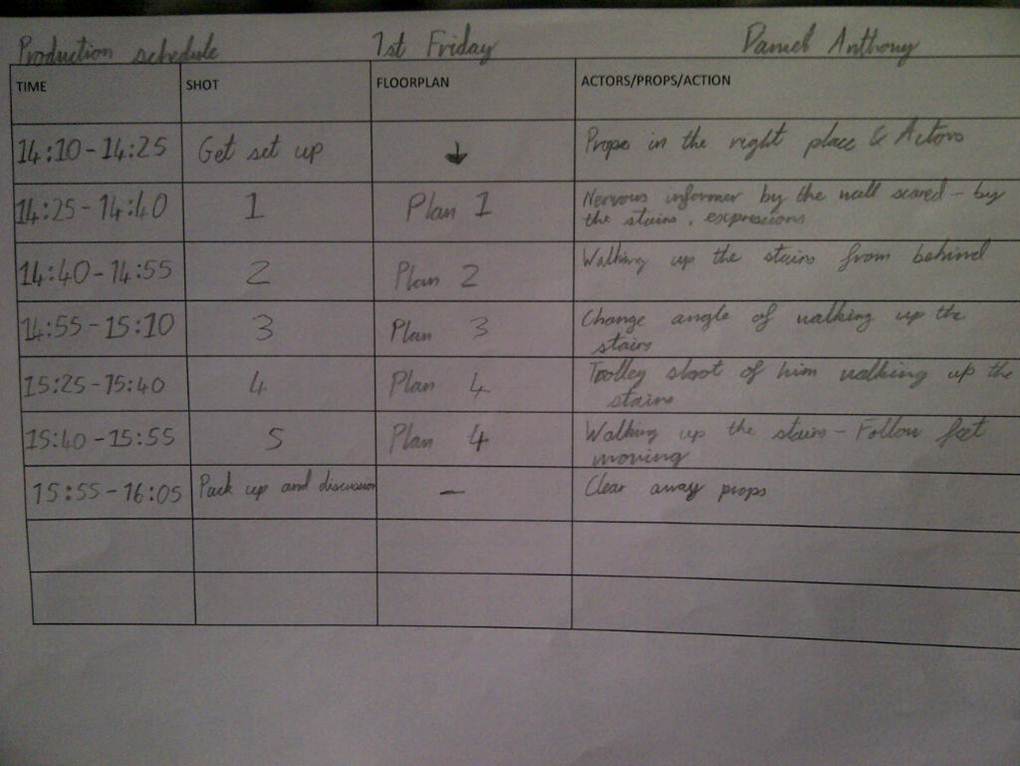
After this, we created a shot list, this was done as it is easier for us to film and cuts out a lot of time as we knew what he had to do at each moment due to the schedule created for us. He described the shots required, scene numbers and descriptions of the shots. So Daniel and I knew where we had to position the camera.


My ventures and how they apply to media.


My ventures and how they apply to media.

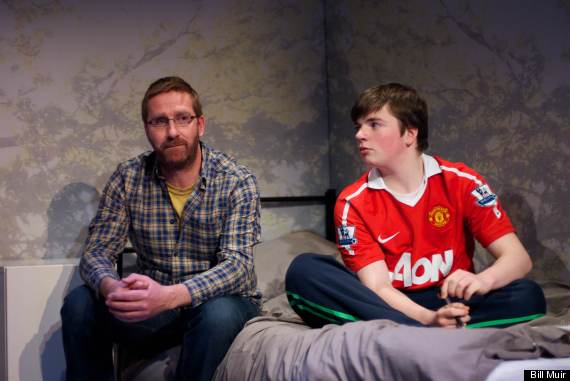
I have recently been in a production of 'where the mangrove grows' in the Latchmere theatre. I played the part of Shaun, a troubled young boys in care. He has a care worker, 'Mike' who has many issues of his own. Shaun has quite a difficult life in the care home and a turbulent relationship with his carer. He owns a book which he 'borrowed' from the library. It is all about African mangrove swamps. When Shaun looks out of the window of his bedroom, he believe he can see a mangrove, however Mike dashes this dream telling him it is an oak tree in a park. When their friendship reaches breaking point, 'Charles' appears. He is an African man who has come to take Shaun away from the clutches of this care home and back to Africa to meet his wife, 'Mrs Charles' and his many children. Whether this is Shaun's imagination or Charles is real, is down to the audience and how they react to the play. One day, Mike catches Shaun trying to climb out of his Attic room window to get down to see Charles.. He can also see that Shaun has broken his chair in making a paddle with which Charles and Shaun can travel into the mangroves. However Mike walks in before Shaun can escape and performs a devastating act of abuse on Shaun, this violation drives Shaun to commiting suicide. He hangs himself by the red tie given to him by Mike earlier in the play.

The play is very topical at the moment. It mirrors what is occuring in the media today, in specific, the Jimmy Saville case. The media are presenting him as a total villain who did this just because he could. However the play explores the inner workings of a 'paedophiles' mind, and particularly, what drives them to carry out these disgusting acts. There are many psychological issues with abusers which should be taken into account, it isn't the 1 dimestional casre that the media present it to be. The play didn't show Mike to be a victim, what he did was wrong, however we explored issues with family, home life, his love for the young boy (my character) and his want for Shauns attention. Shaun, of course, is the victim in this tale of woe, however Mike isn't the monster the media would portry him to be, he and Shaun shared many happy moments throughout the play, and it was only the very end when this is abuse occurred.

Mrs Browns Boys


Mrs Browns Boys.

I recently saw a comedy series about an Irish grandmother who has a house full of her grown up kids. The series follows her day to day life with her children and the issues she has to face, usually because of them. She is a conventional old lady however, she swears, she drinks and makes inappropriate jokes with her friend: 'Winny.'

I like this program as it doesnt try to hide the fact it is in a studio and often makes 'mistakes,' forexample a camera man might get in the shot, the actor playing playing Agnes Brown would then acknowledge this and make a joke out of it. I think this is hilarious as it isnt trying to fool the audience and even though it breaks the idea of being emmersed in the program itself, the keep the audiences attention the whole way through and usually these mistakes as to the humour.
This is one of the moments where they break the illusion and allow us to laugh with the actors:

Mrs Browns boys often uses cuts, however, there was a moment when Agnes forgot her handbag at 'home' so she walked out of the pub set and along the floor to her sitting room to get the bag. This was done for humour and instead of the director using an elliptical cut - The camera followed her and we saw the edges of sets, etc.. This took the Alfred Hitchcock style of film making where you dont use cuts and follow the seen through sets, etc.. And used it in a comedic way.

I also enjoy the moments when Mrs Brown talks directly to the audience. We know there is an audience as we see them during the opening credits, which again breaks the illusion however it doesnt matter as it makes the comedy of the show more effective.

This the moment where Mrs Browns has mistaken drugs for sleeping pills and is feeling the effect.